
Published: November 2, 2026
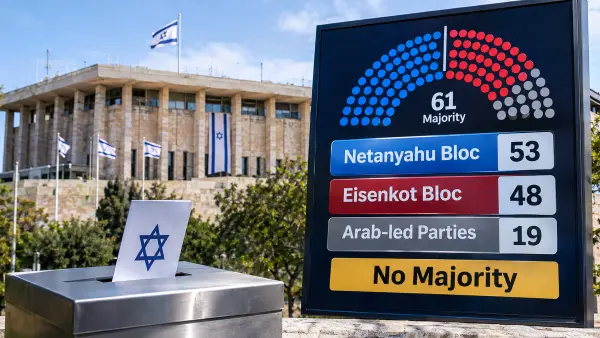
Israel’s October 27 election produced no governing majority. The final count from the Central Elections Committee gave Prime Minister Benjamin Netanyahu’s bloc 53 of the Knesset’s 120 seats and the opposition bloc led by former military chief Gadi Eisenkot 48, both short of the 61 needed to govern. Arab-led parties won a combined 19 seats, the highest total they have ever held.
Netanyahu’s Likud remains the largest party, with 27 seats according to the final party breakdown, ahead of Eisenkot’s Yashar at 21. The election committee rejected claims of systematic interference with the vote, after Netanyahu’s camp raised questions about the result. President Isaac Herzog receives the official results on November 4 and then opens consultations on who should be asked to form a government.
What It Changes
The Israel snapshot described a country governed since December 2022 by Netanyahu’s right-wing and religious coalition, with the election as the test of whether that arrangement would survive. The answer is that it did not win, but the opposition did not win either.
The arithmetic now runs through the Arab-led parties. The Jewish-led anti-Netanyahu parties and the Arab-led parties together hold 67 seats, but Yashar, B’Yachad, and Yisrael Beytenu have said they will not sit in a coalition with Arab parties, according to Times of Israel reporting. That leaves three broad paths. One is a minority government led by Eisenkot and supported from outside the coalition by Arab parties. Another is a unity government, which Eisenkot has rejected if it means serving under Netanyahu, even in a rotation. The third is another election, a familiar outcome in a country that held five between 2019 and 2022.
The ultra-Orthodox United Torah Judaism party has also loosened its ties to Netanyahu. It says it is no longer bound to either bloc and will not join any government that does not pass a law on military service for yeshiva students. Several Hebrew-language outlets report it could back an Eisenkot-led government from outside, though the party has not confirmed this.
The result also reopens the Palestinian question at the diplomatic level. On October 29, Palestinian Authority President Mahmoud Abbas told Cyprus’s president in Nicosia that he was ready to talk with whatever Israeli government emerges and asked Cyprus to mediate. Cyprus signed a defence agreement with Israel three days earlier, and no Cypriot initiative has been announced.
Perspectives
Yair Golan, whose Democrats won eight seats, argued that Netanyahu lost once Arab parties are counted with the opposition, and he is the only anti-Netanyahu leader openly backing cooperation with them. Ahmad Tibi of the Joint List said his party would recommend a Zionist candidate opposed to Netanyahu and offer outside support, and Ra’am is expected to recommend Eisenkot, according to the Jerusalem Post.
Netanyahu’s side frames the same numbers differently. In his post-election remarks, Netanyahu suggested a government that relies on Arab parties would endanger Israel, a statement opposition leaders condemned. A Likud lawmaker said Netanyahu wants a unity government with Herzog and US President Donald Trump as guarantors, while the Likud whip rejected any rotation that would give Netanyahu only part of the term.
Herzog, speaking on November 1, urged party leaders to accept the result as it is and look for creative ways to avoid another election. Israeli media read this as a push toward a unity arrangement. The election committee’s acting director general said there was no basis for allegations of election theft, and police said they would examine any credible complaint, ABC News reported.
What to Watch
Herzog’s consultations this week will show which candidate collects more recommendations and therefore gets the first mandate. The new Knesset is sworn in on November 10, and the anti-Netanyahu parties plan to replace Speaker Amir Ohana quickly. That vote is the first practical test of whether a majority that includes Arab parties can function on the floor. Positions from Naftali Bennett and Avigdor Liberman, neither of whom has made an unequivocal commitment, and from United Torah Judaism on the military service law will decide which of the three paths stays open.
Related Links
- Israel Politics in 2026
- Israel election result shows no overall majority (Al Jazeera)
- Likud biggest party after all votes counted (Jerusalem Post)
- Herzog signals push for unity government (Times of Israel)
- Final results and election committee response (ABC News)
- Abbas seeks Cyprus mediation (Euronews)
- 2026 Israeli legislative election (Wikipedia)
Discussion Questions
- Should parties that refuse to govern with certain other parties say so before an election, or keep their options open?
- Does your country have parties that are routinely kept out of coalitions? Why?
- Is a minority government with outside support more or less stable than a unity government between rivals?
- Why do some countries hold repeated elections when no one wins a majority, while others find a deal?
- Imagine you are President Herzog. What would you say to Netanyahu and Eisenkot in your first meeting?