
Published: October 17, 2026
Spain will hold a general election on November 29, about eight months ahead of schedule, after Prime Minister Pedro Sánchez announced on October 5 that he was dissolving parliament. The trigger was a defeat in Congress three days earlier, when Junts, the People’s Party (PP) and Vox voted down two government decrees on housing, the issue that had filled Spain’s streets with protesters in the preceding week. Sánchez has framed the vote as a choice between his coalition’s social agenda and what he calls a rising far-right wave; PP leader Alberto Núñez Feijóo says it is a chance to remove a government weakened by corruption cases.
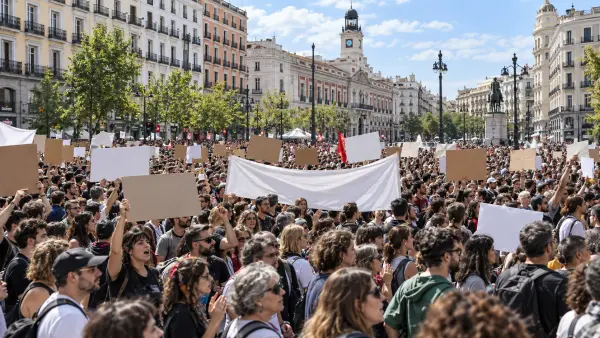
The decrees would have extended eviction protections for vulnerable households until 2030, regulated seasonal and room rentals, barred large investment funds from buying homes until 2028, and made residential leases renewable at the tenant’s choice. The Basque Nationalist Party and Coalición Canaria backed the first decree but not the second. The protests that preceded the vote began after the televised eviction of an 87-year-old woman in Madrid, and grew into weekend marches in more than 50 cities and tent camps in Madrid, Valencia, Bilbao and elsewhere.
What It Changes
The Spain Politics in 2026 snapshot, published in July, asked whether Sánchez could survive to the scheduled 2027 election. He had ruled out both resignation and a snap vote, and the snapshot’s watch list centred on corruption investigations, a missing budget, and the relationship with Junts. That central question is now answered: he will not reach 2027 on the original timetable, and he chose the moment himself.
Housing has moved from background to the main ballot issue. The snapshot named housing and the cost of living as drivers of voter discontent but treated them as context behind the corruption story. The scale of the protests, and the decision to call an election on the back of a housing defeat, makes housing the ground Sánchez wants to fight on. Average rents have nearly doubled in a decade, according to property portal Idealista figures cited by the Associated Press. The issue has also pulled in the main unions: CCOO and UGT have called a 24-hour general strike over wages and housing for November 11, the first joint general strike since 2012.
The break with Junts is now formal. The snapshot recorded that Junts withdrew its support in 2025 over the amnesty’s implementation, but left open whether the relationship could be restored. Voting with the PP and Vox against a flagship measure, after the government offered to rework the texts, settles that for this parliament. Junts argued the decrees would push owners to pull homes from the rental market and drive prices up. The Catalan party’s choice also matters for what follows the election, since any future Socialist-led majority would likely need it again.
The right’s path to a majority is clearer, but it runs through Vox. The snapshot said polls suggested a PP and Vox bloc could take national power, without figures. Every recent private poll with a seat projection puts the two parties above the 176 seats needed for a majority, with combined estimates mostly between about 190 and 205 seats. The state-run CIS is the outlier: its October barometer puts the Socialists ahead on 34%, well above other pollsters, and gives no seat projection. Neither the PP nor Vox is close to a majority alone, so the shape of any right-wing government depends on a deal between them.
Perspectives
Sánchez says he needs to “renew and broaden” his support to do more, and casts the election as a vote on whether Spain resists a wider European shift to the right. Before the Congress vote he told opponents history would judge them for blocking the measures. Housing Minister Isabel Rodríguez said the government had incorporated most of the other parties’ proposals into the texts. Some protesters at the Madrid camp told AFP they expected the mobilisation to favour the left at the polls.
Feijóo accuses Sánchez of calling the vote out of self-interest and to get ahead of what court cases involving his circle may reveal. PP spokesman Juan Bravo called the defeat Sánchez’s own failure. The Basque nationalists and Coalición Canaria, usually government allies, criticised it for governing by decree rather than negotiating legislation. Vox leader Santiago Abascal welcomed the election and has set out conditions for any arrangement with the PP, including what he calls “remigration” of migrants and a “national priority” agenda, terms critics describe as xenophobic. He has also confirmed discreet contacts with Feijóo. The business groups CEOE and Cepyme argue that housing demands should be addressed to governments rather than through a general strike.
On the left of the Socialists, the parties around Sumar are regrouping as a “Broad Front” and have proposed former Barcelona mayor Ada Colau to lead their list, with Podemos negotiating separate regional arrangements. Polls put that space well below its 2023 result.
What to Watch
The November 11 general strike falls two days before the official campaign opens, and its turnout will be an early read on whether housing mobilisation translates into Socialist votes. Watch the gap between the CIS and private polls as the campaign tightens, and whether the left of the Socialists runs as one list or splits. After the vote, the key question is whether the PP governs alone with Vox support from outside, or forms Spain’s first national coalition with the far right, and on whose terms.
Related Links
- Spain Politics in 2026
- Congress rejects housing decrees with no votes from Junts, PP and Vox (Catalan News)
- What the polls for the November 29 election say (Ara)
- CCOO and UGT call a general strike over housing for November 11 (Euronews, Spanish)
- Vox sets out its conditions for governing with the PP (Euronews, Spanish)
- Spain’s government dealt a blow after parliament rejects housing measures (AP)
Discussion Questions
- Is housing a major political issue in your country? Which parties benefit from it?
- Was calling an early election a smart move for Sánchez, or a gamble he is likely to lose?
- Why might a party like Junts vote against housing protections it partly agrees with?
- Imagine you are a renter in Madrid. Would the general strike make you more or less likely to vote?
- Should mainstream conservative parties govern with far-right parties when voters give them a majority together?