Published: November 2, 2026
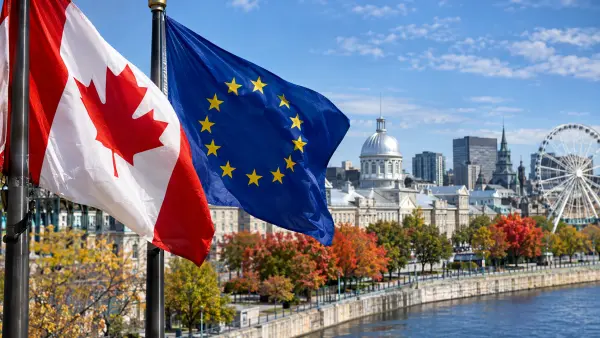
Canada and the European Union launched an “Alliance for the Future” at their summit in Montreal on October 29 and 30, the closest relationship the EU has set up with any country outside the bloc. Prime Minister Mark Carney, European Council President António Costa, and European Commission President Ursula von der Leyen signed a joint declaration covering trade, investment, energy, defence, and technology. The phrase “associate membership,” which von der Leyen had floated in September, was left out after objections from member states.
The summit closed several concrete deals. The two sides concluded a digital trade agreement and a competition cooperation agreement, and Canada signed a framework with the European Investment Bank to finance critical minerals projects. Canada will also join the EU’s supercomputing network, take part in procurement under the EU’s SAFE defence instrument, and open talks on wider access to the Erasmus+ exchange program.
What It Changes
The Canada snapshot described a government trying to reduce Canada’s dependence on the United States after Trump-era tariffs, with Europe as the main alternative. The baseline until now was the 2016 Comprehensive Economic and Trade Agreement (CETA), a trade deal. The Montreal declaration moves the relationship from trade toward security, defence procurement, and research, and the Commission has recommended opening negotiations on a broader Economic Integration Agreement.
The scale of the task is clear from the trade numbers. The United States took 71.7% of Canada’s merchandise exports in 2025, and Carney has set a goal of doubling exports to other countries over the next decade. A political alliance does not change that figure quickly.
What did not change is Canada’s legal status. Germany led the objections to the associate membership label, with France, Italy, and Greece also raising concerns, because the term does not exist in the EU treaties and could carry legal consequences, Euronews reported. The declaration instead commits to an “ever closer association” to be defined by the 2027 summit. Carney still describes the destination as associate membership, so the two sides are using different words for the same process.
For the EU, the arrangement is a template. Von der Leyen said Canada cannot become a full member, and the alliance is designed so other like-minded countries could join later. German Chancellor Friedrich Merz had earlier floated a similar intermediate status for Ukraine.
Perspectives
Carney framed the alliance as a question of sovereignty and resilience against economic shocks. Costa called Canada the most European of the non-European countries. Before the summit, Carleton University political scientist Achim Hurrelmann said the agreement appeared to be assembled in a hurry and that he expected little detail, CTV News reported.
Domestic criticism comes from different directions. The Bloc Québécois said the new status must be negotiated with Quebec, since parts of the agreement touch provincial jurisdiction. Conservative leader Pierre Poilievre said in September that Canada would never be the 28th state of the European Union.
In Washington, Trump suggested the arrangement could be a hostile act and threatened tariffs on Europe if he judged it unfriendly. For the EU, the alliance is partly a response to US trade pressure as well, and it commits both sides to keep up pressure on Russia and support Ukraine’s recovery.
What to Watch
Canadian ministers and European commissioners are due to meet in March, and Carney plans to attend European Council meetings in June to conclude talks. EU governments still have to approve a negotiating mandate for the Economic Integration Agreement. Two other tests are whether Ottawa brings the provinces, and Quebec in particular, into the process, and whether Washington follows through on tariff threats.
Related Links
- Canada Politics in 2026
- Carney expects to conclude talks in June (ABC News)
- EU removes mention of associate membership (Euronews)
- Canada, EU close Montreal summit (Canadian Press via inSauga)
- Summit documents and agenda (IEU Monitoring)
- Library guide on EU-Canada relations (Council of the EU)
Discussion Questions
- Should a country outside Europe be able to join parts of the EU without becoming a full member?
- Does it matter whether this relationship is called an alliance or associate membership?
- Which country does your country depend on most for trade? Is that a risk?
- Why might EU members be cautious about creating a new type of membership?
- Imagine you lead a Canadian province. What would you want from Ottawa before it signs a deeper EU deal?