Published: October 20, 2026
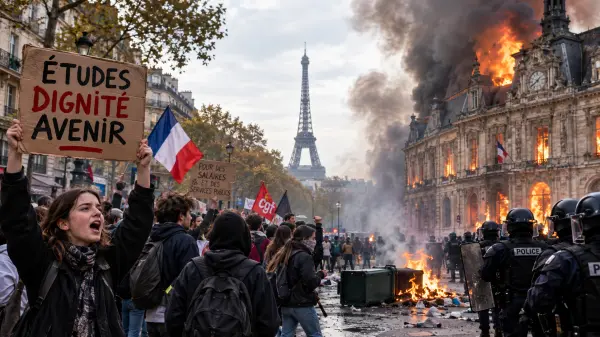
A student-led protest movement over school conditions in France merged on October 17 with a wider revolt over living costs, and the largest day of mobilization so far ended in rioting, looting and arson in Paris and other cities. The movement began in mid-September over overcrowded classrooms, teacher shortages and the Parcoursup university admissions platform, and most participants on October 17 marched peacefully.
Interior Minister Laurent Nuñez put turnout at about 550,000 nationwide, while organizers claimed about 800,000. Police made well over a thousand arrests by Sunday, and the historic city hall in Limoges was deliberately set on fire. Reports on fatalities differed between outlets as of October 20, and the circumstances of at least one death were under investigation.
The weekend followed weeks of escalation. A national day of action on October 6 had already drawn about 266,000 people, according to Public Sénat’s account of the movement’s third act. Official and organizer counts differ on every major day, and casualty and arrest figures were still changing, so this post describes the situation rather than a tally.
What It Changes
Street pressure is no longer sectoral. Earlier protest waves in the France reference pages were tied mainly to budget austerity and union calendars. This wave fused high school and university students, teachers, the CGT union, former “yellow vests,” farmers and climate activists in a single day of action. A movement that started over classroom conditions now carries a general cost-of-living grievance, which is harder for any one ministry to answer.
The 2027 presidential race has moved onto the street. Leaders across the spectrum began trading blame within hours, with the election expected next spring. Marine Le Pen and Jordan Bardella of the National Rally cast themselves as the party of order, and Bardella demanded that far-left militant groups be designated as terrorist organizations, as CNN’s analysis noted. Jean-Luc Mélenchon of La France Insoumise, who joined the Paris march, accused the government of provoking the violence through its policing.
Public order has become a governing issue, not only a policing one. The government has accelerated its “casseurs-payeurs” bill, which would make people in a group that commits damage liable for the costs even if they did not cause it. Interior Minister Nuñez had earlier suspended stun grenades for school protests, and prefects banned demonstrations near closed schools after violence on October 1. The France reference pages treat the government’s room to maneuver as limited by a fragmented Assembly; this episode adds a law-and-order test to that constraint.
Perspectives
The government. President Emmanuel Macron said in a televised address that those who sought to bring down the Republic would be held accountable. He blamed insurrectionist far-left elements and criminals for the violence while describing the protesters’ underlying claims as legitimate. Nuñez said the right to protest is fundamental and deliberate violence is not. Prime Minister Sébastien Lecornu told critics that no one can call for an end to the violence while excusing those who commit it.
The left. Mélenchon said people who share the movement’s fight have no business in looting or destruction, while arguing that the government’s tactics united youth and unions against it. The CGT backed the protests and called for higher wages and pensions, lower prices and protection of public services.
The right. Le Pen said rioters had spoiled a demonstration about purchasing power. Her party’s leadership framed the weekend as proof that order must be restored.
International reaction. US President Donald Trump posted that France was burning and linked the unrest to immigration. The Associated Press reported that French authorities and police have not linked immigrants to the rioting and have attributed violence to far-left groups and opportunistic looters. A CNN analysis described the weekend as a symptom of a wider political and economic crisis, which is an interpretation rather than a finding.
What to Watch
The government’s first responses to student demands, promised for roughly the end of October, and whether Lecornu can fund them without cuts elsewhere, as he has said he must. Whether the student and cost-of-living tracks stay merged or split after the violence. The fate of the “casseurs-payeurs” bill and of reported proposals for partial curfews, the latter from a lower-quality source that should be confirmed. How the violence shapes the polling of Le Pen, Mélenchon and the governing camp before the spring election.
Related Links
- France Politics in 2026 (PoliTalking snapshot)
- All PoliTalking coverage of France
- Al Jazeera: Paris left reeling as student-led protests turn chaotic
- AP via CBS News: French police arrest more than 1,800 people
- CNN: The rioting across France is a symptom of a larger crisis
- Public Sénat: Mobilisation lycéenne (French-language coverage)
- Sud Radio and AFP: Mobilisation des lycéens (French)
Discussion Questions
- Have students or workers in your country protested over living costs or public services? What happened?
- Why might a school-conditions protest grow into a general protest about prices?
- Should a government treat peaceful marchers and rioters as separate groups? How?
- Leaders in France blamed each other within hours. Why do you think this happens after unrest?
- Imagine you are the prime minister with a limited budget and a movement in the streets. What is your first announcement?