
Published: October 26, 2026
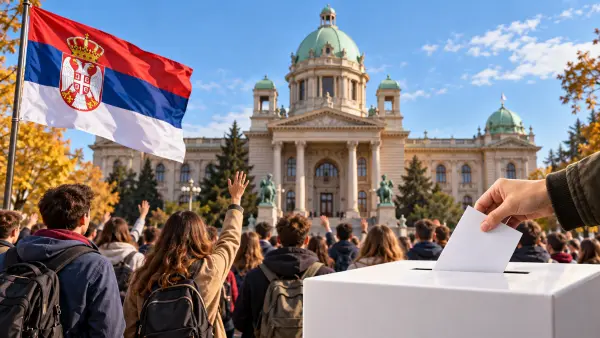
Serbia’s snap parliamentary election on October 25 ended with the Student List, a citizens’ list built out of nearly two years of anti-corruption protests, on course for an outright majority in the 250-seat National Assembly. Aleksandar Vučić, who resigned the presidency in September to lead the ruling Serbian Progressive Party (SNS) list as its candidate for prime minister, conceded on election night, saying a stratified sample showed his list had lost. He put the Student List at 135 to 140 seats and his own list at around 105.
Independent projections point the same way. A joint CeSID and Ipsos projection gave the Student List about 52 percent and roughly 139 seats, with the “Aleksandar Vučić, United Serbia” list near 39 percent. The monitoring group CRTA reported a similar margin. Official results from the Republic Electoral Commission (RIK) were still pending at the time of writing, and turnout was the highest in decades.
What It Changes
The end of SNS dominance. The SNS has been in government since 2012, and Vučić has been the country’s central political figure as prime minister and then president. Serbia’s standing political picture has rested on that dominance: a ruling party with a reliable parliamentary majority, a fragmented opposition that often boycotted or split, and repeated criticism from election observers about media access and abuse of state resources. A Student List majority removes the first of those conditions outright. If the projected seat totals hold, the new majority can form a government without coalition partners.
A new kind of governing force. The Student List is not a conventional party. Its candidates, including academics and other public figures, were selected through student assemblies, and no current students appear on the list. Several opposition parties stood aside to back it, while others ran separately. That structure was a campaign strength, but it means the incoming majority has no governing record, no established party organization, and, as of this writing, no publicly confirmed candidate for prime minister. Its stated priorities were education, healthcare, the judiciary, crime, and corruption, with little detail on foreign policy.
The old coalition partner is out. The Socialist Party of Serbia (SPS), running as Ivica Dačić’s “Factor of Stability” list and a fixture of SNS-led governments, fell below the 3 percent threshold in early projections. According to Vučić’s own account, only the two main lists and minority parties, which are exempt from the threshold, won seats. A two-bloc parliament would be a sharp break from the multi-party assemblies of the past decade.
The presidency is open. Vučić’s resignation on September 27 made parliamentary speaker Ana Brnabić acting president and triggered a presidential election that must be held within roughly three months. Vučić is barred from that race after two terms. Serbia now faces a second national vote before the new government has settled in, with the SNS in opposition for the first time in fourteen years.
Perspectives
Vučić accepted the result but blamed independent media, unnamed European governments, and what he called an “American deep state” for his list’s defeat. During the campaign, SNS figures including Ana Brnabić dismissed the Student List as a fraud. Student List candidates described the result as a victory over fear and a vote for a different kind of state. Dragan Đilas, a leader of the separate pro-European opposition list, congratulated the Student List and called the outcome a choice for a European future, a framing the Student List itself has not centered.
Monitors and the Student List both reported problems with the conduct of the vote. CRTA reported pressure on voters or poll workers at almost a third of the 500 polling stations it observed, and CeSID logged hundreds of reports of possible irregularities, including group voting and ballot photography. The Student List also reported irregularities in Niš and southern Serbia during the day. None of these reports has so far been presented as changing the outcome.
Internationally, the vote was closely watched in the European Union, where Serbia has been a membership candidate with stalled progress on rule of law, alignment with EU foreign policy, and normalization with Kosovo. Vučić spoke with Vladimir Putin the day before he resigned, and the Kremlin said afterward that it expected contacts with Serbia’s new leadership to continue. Some Western and Ukrainian outlets have framed the result as a turn away from Moscow, but the Student List has not set out a foreign policy program that would confirm or rule out that reading.
What to Watch
First, the official count. Early partial RIK results, drawn from the first 203 polling stations processed, showed United Serbia ahead, while projections based on representative samples showed the reverse. That gap reflects which stations reported first, but the final RIK tally and any formal complaints will set the seat count. Second, government formation: who the Student List nominates as prime minister, and how a movement without a party structure staffs ministries. Third, the presidential election date and candidates, including whether the SNS can field a figure with Vučić’s profile. Fourth, early policy signals on the EU accession process, Kosovo, and energy, where analysts have pointed to near-term deadlines on US oil sanctions and Russian gas supply.
Related Links
- Serbia Politics in 2026
- Judicial Independence
- Euronews: Vučić concedes as Student List wins
- Danas: Election night live coverage (Serbian)
- CNN: Vučić concedes to student-led movement
- The Conversation: Why Vučić resigned the presidency
- Geopolitical Monitor: Serbia’s energy deadlines
Discussion Questions
- Has a protest movement in your country ever turned into an electoral force? What happened?
- Is it an advantage or a risk for a new governing majority to have no party structure?
- Why might early official vote counts differ so sharply from sample-based projections?
- Should outside governments comment on another country’s election results? Why or why not?
- Imagine you are advising the Student List on its first month in government. What would you tell it to do first?