
Published: November 13, 2026
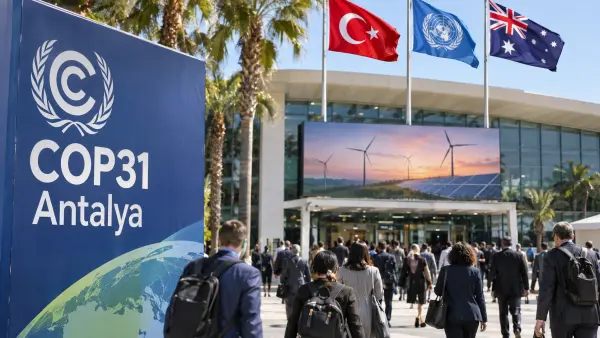
The 31st UN climate summit, COP31, opened in Antalya on November 9 under an unusual shared arrangement: Türkiye holds the presidency and runs the voluntary Action Agenda, while Australia chairs the formal negotiations. The talks began with a late-night fight over money. Developing countries pushed to add climate finance items to the official agenda, and a climate finance work programme was included, but African demands for a separate item on tripling adaptation finance were folded into other discussions instead.
The Antalya Leaders’ Summit followed on November 11 and 12. China sent Vice-President Han Zheng rather than Xi Jinping, the leaders of France, Germany and Italy stayed away, and the United States sent no federal officials, although a congressional delegation attended. The Turkish presidency used the week to launch its headline initiative, a voluntary pledge to raise electricity’s share of global final energy use to 35% by 2035. Formal negotiations continue through the scheduled close on November 20.
What It Changes
For Türkiye. Hosting COP31 is the country’s largest climate diplomacy role since it ratified the Paris Agreement in 2021, and the government has framed it as proof of Ankara’s reach as a convenor. The summit also puts Türkiye’s own energy mix under scrutiny. Coal generated about a third of Turkish electricity last year, and President Erdoğan used the week to highlight rising domestic oil output from the Gabar fields. The presidency’s flagship electrification pledge does not require new power to come from clean sources, a design choice that matches the government’s stated view that climate targets must fit national economic realities.
For Australia. Canberra gave up its bid to host in Adelaide in exchange for running the negotiations, and Climate Minister Chris Bowen now carries responsibility for whatever text emerges. That role sits alongside Australia’s position as a major coal and gas exporter, with coal supplying over 40% of its own electricity last year according to the same Reuters reporting. Türkiye has said publicly that it holds the “final decision” at the summit, so any public divergence between the two governments in week two would test the power-sharing deal agreed at COP30.
For the global climate regime. COP31 is the first summit since the UN accepted that overshooting 1.5C is now unavoidable, with warming projected to peak around 1.7C to 1.8C by mid-century. The fossil fuel question has moved outside the formal process: Brazil published a voluntary 182-page roadmap on November 3 that asks countries to draft national transition plans by 2028 and begin major production cuts around 2030. Whether the Antalya cover decision references that roadmap at all is one of the main open fights. New data released during the summit indicated that fossil fuel carbon emissions stayed broadly stable in 2026, rather than falling.
Perspectives
UN Secretary-General António Guterres, who steps down at the end of the year, urged leaders to “get serious by cutting emissions faster.” He also criticised oil companies for windfall profits since the Iran war disrupted Middle East energy shipments. COP31 President Murat Kurum has argued that wider electrification will reduce fossil fuel use on its own, and he confirmed that low-carbon sourcing is not a condition of the pledge.
That point drew the sharpest criticism from environmental groups. Beyond Fossil Fuels warned that electrification could become a cover for new fossil fuel consumption, while the head of Greenpeace’s delegation called the opening days “a difficult start.” The International Energy Agency took a middle position, finding that raising electricity’s share from 23% today to around 33% is already cost-effective with existing technology, which puts the 35% target within reach but leaves the source of the power open.
Resistance came from the other direction too. India’s Environment Minister Bhupender Yadav said before the summit that India would not sign the electrification pledge, calling it the presidency’s own agenda. India, Saudi Arabia and China are also expected to resist a stronger mandate for the mitigation work programme, which least developed countries and small island states want tied to the 2023 commitment to transition away from fossil fuels.
On finance, a senior EU official warned there would be no political will for new funding pledges in Antalya, and the EU has said it arrived without new money. African negotiators, backed by many developing countries, want a concrete figure and timeline for the COP30 promise to at least triple adaptation finance by 2035. A UN assessment cited ahead of the talks found that even tripling would cover only about a third of developing countries’ adaptation needs. Separately, Amnesty International has raised concerns about a clause in the hosting agreement telling participants not to interfere in Türkiye’s internal affairs, arguing it could chill free expression at the venue.
What to Watch
Ministers arrive for the second week, when the cover decision text takes shape. Key tests include whether the text mentions Brazil’s fossil fuel roadmap, whether the mitigation work programme is renewed and strengthened, and whether a just transition mechanism is formally established. The presidency also wants the electrification goal written into the formal outcome, which would require consensus that India’s stance makes unlikely. A trade agenda item requested by the African Group and supported by China’s concerns over cleantech trade barriers remains contested, with European resistance expected. UN climate summits often run past their scheduled end, and Ethiopia takes over as host of COP32 in 2027.
Related Links
- Türkiye Politics in 2026 (PoliTalking.com)
- Australia Politics in 2026 (PoliTalking.com)
- Renewable Energy: Global Politics and Policy (PoliTalking.com)
- COP31 briefing: what to expect from the Antalya climate summit (Climate Home News)
- Antalya Leaders’ Summit at COP31 (UNFCCC)
- 35-by-35: coalitions are key to land electrification goal at COP31 (ODI)
- Erdoğan holds series of bilateral meetings on sidelines of COP31 (TRT World)
Discussion Questions
- Should a climate pledge count electricity from coal and gas the same as electricity from solar and wind?
- Why do you think so many major leaders chose not to attend the summit in person?
- Has your country signed or opposed any of the voluntary pledges made at recent climate summits?
- According to the article, what are the main disagreements over adaptation finance?
- Imagine you are Australia’s chief negotiator. How would you handle a disagreement with the Turkish presidency in public?